.png)
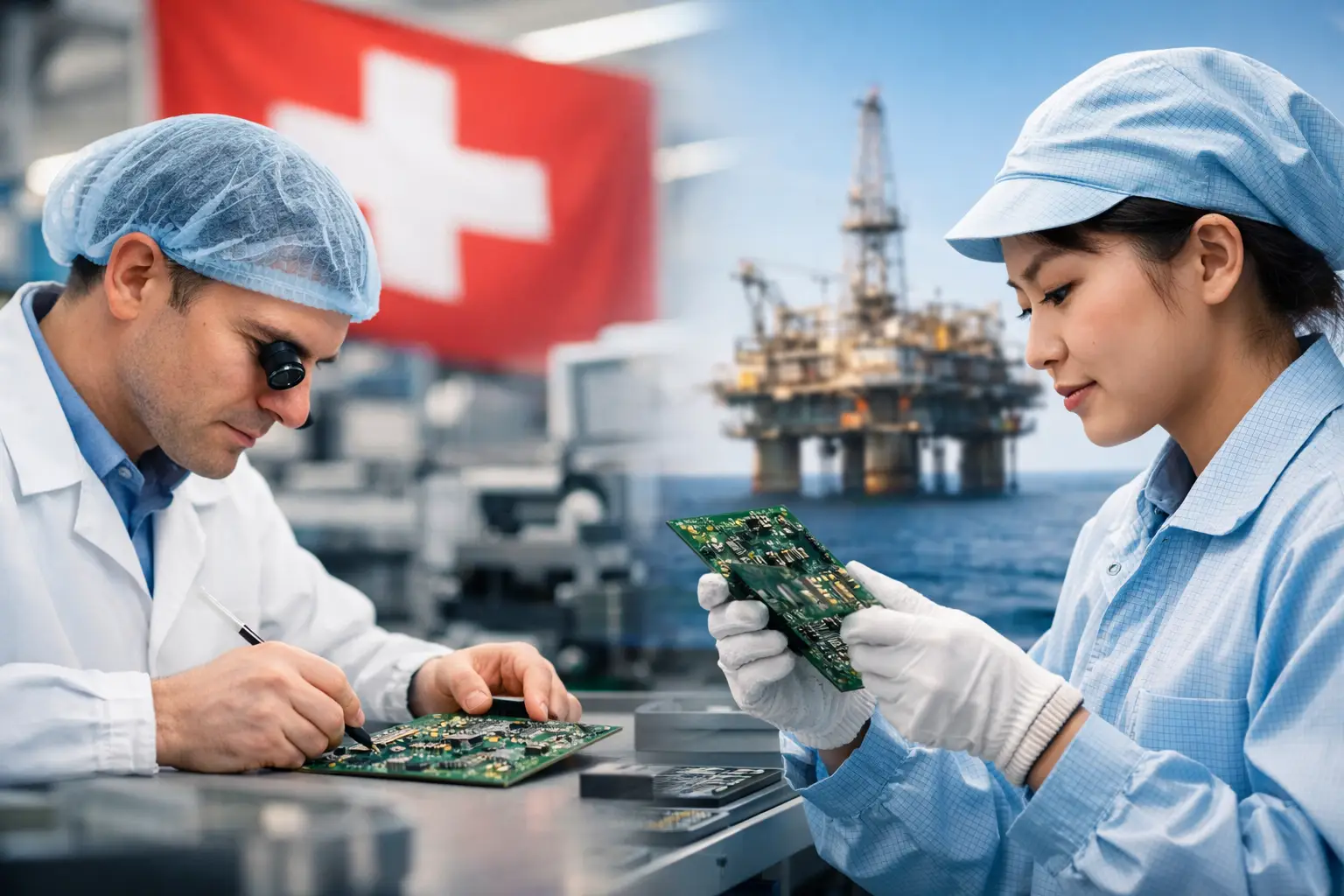
A production quotation can make offshore assembly look compelling, particularly when a bill of materials is stable and annual volumes are high. But the purchase price of a populated PCB is only one part of the decision. For electronic products that are still evolving, require dependable traceability, or must reach the market on a fixed date, the choice between Swiss versus offshore manufacturing has direct consequences for engineering time, quality control and supply-chain risk.
The right answer is not always Swiss production. Offshore manufacturing can be a sound model for mature, high-volume products. The key is to assess the complete operating picture: how often the design changes, who needs to make decisions, how costly a delay would be, and what level of ownership is needed after the first shipment.
Swiss versus offshore EMS: the real comparison
Comparing Swiss and offshore electronic manufacturing services only by unit cost can produce the wrong result. A better comparison looks at the total cost of bringing a product from design release to reliable, repeatable delivery.
A Swiss EMS partner typically operates closer to the product team. Engineers, buyers, production specialists and project managers can clarify issues quickly, often in the same working day. This is particularly valuable during prototyping, pre-series production and industrialisation, when a small change to a component, layout or test procedure can affect the entire project.
Offshore production usually offers a lower direct labour cost and may be attractive when assembly volumes are substantial. However, it can introduce longer transport routes, more complex communication, minimum order quantities, extended lead times for corrections and less immediate access to the people building the product. None of these factors is automatically unacceptable. They simply need to be included in the commercial and technical calculation.
For a medical-adjacent device, industrial controller, measurement system or connected product, a delayed corrective action can cost more than the saving made on assembly. The same applies when a product is being introduced to customers and the first production lots need close attention.
When Swiss manufacturing creates operational value
Swiss production is often selected because it gives companies greater control at the stages where control matters most. It is not only about geography. It is about having a partner that can connect engineering decisions to factory execution without multiple handovers.
Faster design-to-production feedback
A prototype that works on the bench is not necessarily ready for serial production. Components may be difficult to source, soldering profiles may need adjustment, test points may be missing, or mechanical tolerances may create assembly issues. If engineering and manufacturing are coordinated closely, these findings can be resolved before they become recurring production faults.
Short feedback loops are especially useful for startups and R&D teams with limited time. Rather than sending files to one supplier, waiting for feedback, and then coordinating changes with another production site, teams can work through design for manufacturing, purchasing alternatives, programming and test requirements within one project structure.
Traceability and controlled quality
For many business-critical electronics products, traceability is a requirement rather than a preference. Companies may need to know which components were used in a specific lot, which process controls were applied, what test results were recorded and how a later field issue can be isolated.
A local EMS operation can make those controls more accessible. Customers can review processes, discuss non-conformities directly and agree how serial numbers, material batches, inspection records and test data will be managed. This supports quality assurance during production and provides a clearer basis for repair, rework or product updates later in the lifecycle.
Practical access to the factory
Factory visits are not needed for every project, but they are highly useful when a product is new, technically sensitive or moving from a pilot build to regular deliveries. Being able to meet the production team, inspect a first article, review a test fixture or resolve an assembly question in person reduces uncertainty.
For Swiss and European teams, local manufacturing also makes communication more practical. Working hours overlap, technical discussions are faster, and project decisions do not wait several days for a response across time zones.
Where offshore manufacturing can be the right choice
Offshore manufacturing deserves consideration when a product has reached a high degree of maturity. If the design is frozen, documentation is complete, test processes are well established and demand is predictable, scale can change the economics significantly.
High-volume consumer electronics are a common example. In these cases, established offshore supply ecosystems may provide competitive purchasing conditions, specialised process capacity and production output that would be difficult to match locally. A company that has strong internal supplier management, clear quality documentation and enough inventory planning capability may manage this model successfully.
The risk increases when a team applies a high-volume offshore model to a low-volume or fast-changing product. A component substitution then becomes more than a purchasing decision. It may require new samples, engineering approval, revised production files, transport planning and a new production slot. What appears inexpensive at order placement can become expensive when the product changes.
The question is therefore not whether offshore manufacturing is good or bad. It is whether the product and operating model are sufficiently stable to absorb the distance, lead time and coordination effort.
The costs that do not appear on the assembly quote
A serious sourcing decision should include costs beyond PCB assembly. Transport, customs administration, insurance, inventory carrying costs, incoming inspection, travel, communication overhead and potential rework all affect the final result. So does the value tied up in stock when long transit times require larger safety buffers.
Component availability is another major factor. Electronic supply chains can change quickly. When an approved component becomes unavailable, the best response is often a rapid technical and purchasing discussion: identify alternatives, verify form-fit-function implications, update documentation and maintain delivery commitments. This process is easier when the engineering and procurement teams are closely connected.
Quality failures also have a different cost profile depending on location. A defect found at a local production site can sometimes be contained, analysed and corrected before dispatch. A defect found after a large overseas shipment has arrived may require sorting, returns, replacement stock and customer communication. For products used in industrial applications, the commercial impact can exceed the original manufacturing saving.
Choose the model by product lifecycle stage
The most effective strategy is often not a permanent choice between two locations. It is a decision that follows the product lifecycle.
During concept development, prototyping and 0-series work, proximity and technical collaboration usually have the highest value. The goal is to prove the design, establish a manufacturable process, define testing and obtain reliable supply-chain data. At this stage, a responsive Swiss partner can prevent weak assumptions from becoming embedded in the product.
During market launch and early serial production, flexibility remains important. Demand forecasts may change, product revisions may be required, and customer feedback can lead to improvements. Shorter replenishment routes and direct project coordination help reduce the risk of excessive stock or long delays.
Once a product is technically stable and demand is consistently high, companies can reassess the manufacturing footprint. Some will keep production in Switzerland because quality, responsiveness or customer requirements justify it. Others may use a hybrid model, with Swiss engineering, pilot builds, critical assemblies or final configuration supported by offshore capacity for selected volume work.
The best model is the one that protects product performance and commercial commitments at each stage, rather than forcing every stage into the same cost structure.
Questions procurement and engineering should answer together
The sourcing decision should not sit solely with procurement or solely with engineering. Both functions see different risks. Procurement understands supply conditions, contractual exposure and cost drivers. Engineering understands design maturity, test coverage and the consequences of change.
Before selecting a manufacturing route, teams should establish whether the bill of materials is genuinely stable, whether approved alternatives exist for critical parts, how production testing will be performed, and how failures will be handled. They should also define acceptable lead times for engineering changes and replacement units, as well as the traceability needed for the product's market and application.
A supplier should be assessed on more than equipment and price. Ask how it manages component shortages, communicates non-conformities, supports design changes, protects production data and continues support after delivery. These are the practical details that determine whether a manufacturing relationship remains dependable under pressure.
A decision built around accountability
For companies developing sophisticated electronics, the strongest manufacturing option is usually the one with clear accountability from the first design review through delivery and after-sales support. Hemargroup brings engineering, Swiss production, procurement coordination, warehousing and lifecycle services into that single chain of responsibility.
The decision between Swiss and offshore production should be made with a clear view of the product's maturity, risk profile and commercial targets. A lower unit price has value, but so do fast corrective action, controlled quality and the ability to speak directly with the people responsible for the build. When the product changes or the market puts pressure on delivery, those capabilities become measurable business advantages.