.png)
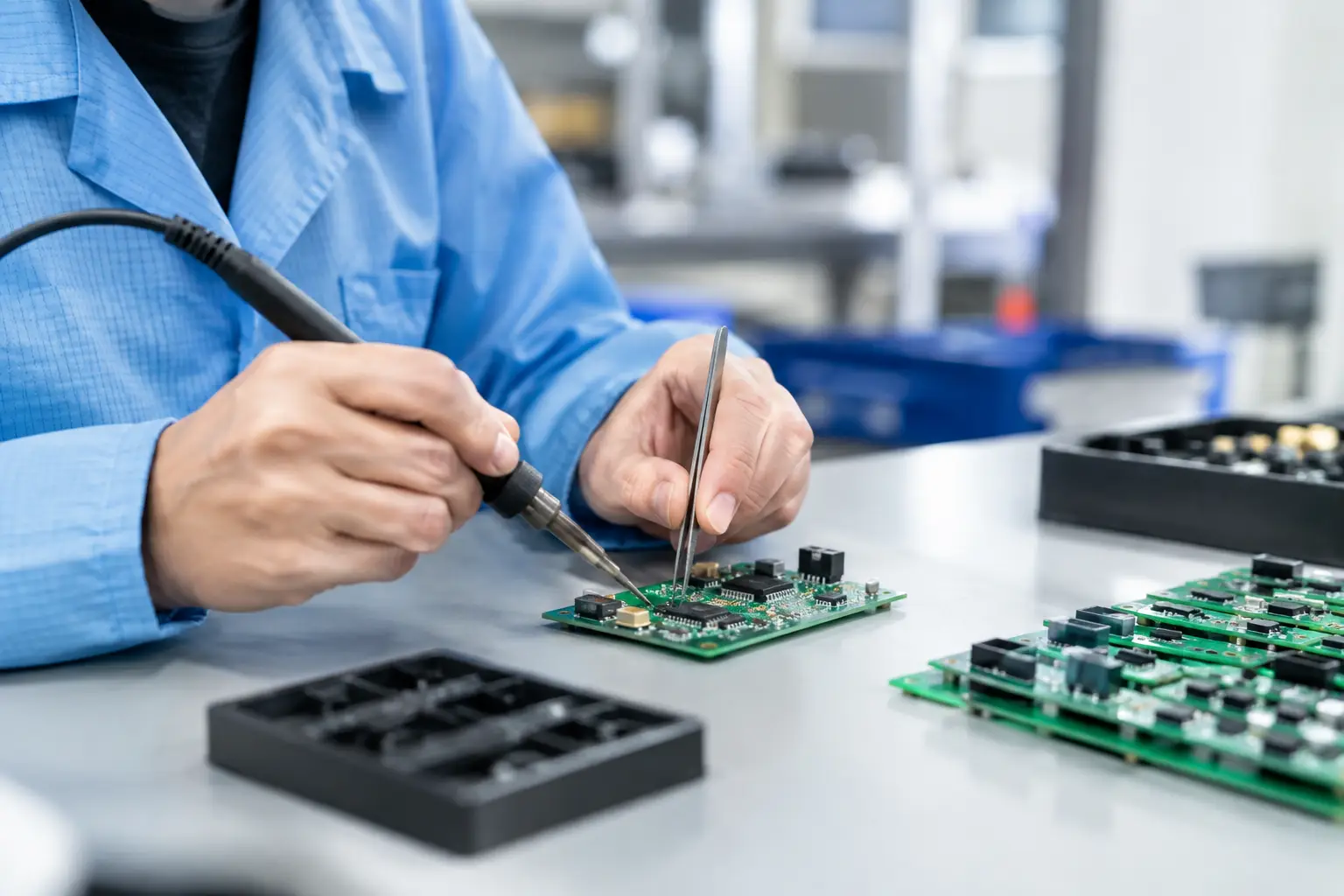
A working prototype is not yet a manufacturable product. The gap between a bench-tested board and a device that can be built repeatedly, inspected, programmed, packed and supported is where many launches lose time. Low volume manufacturing gives product teams a controlled way to cross that gap without committing immediately to the cost, inventory exposure and process rigidity of high-volume production.
For industrial companies, technology ventures and startups, the value is not simply a smaller order quantity. It is the ability to learn from real production while keeping engineering, sourcing and quality decisions close to the product.
What low volume manufacturing means in electronics
Low volume manufacturing is the production of a limited number of electronic assemblies or finished devices, typically after prototype validation and before, alongside or instead of mass production. The actual quantity varies by product and business case. It may be a few dozen units for field evaluation, several hundred units for an initial market release, or recurring batches for specialised industrial equipment.
What matters more than the number is the operating model. A low-volume run must produce units with defined materials, documented processes, inspection criteria and traceability. It should not be treated as a collection of prototypes assembled one by one. At the same time, it needs enough flexibility to accommodate design refinements, customer feedback and component changes.
This model suits products with uncertain demand, long qualification cycles or a high degree of configuration. Medical-adjacent equipment, industrial controls, laboratory instruments, connected devices and professional electronics often benefit from it. It is also practical when a product will remain a niche, premium or serviceable device throughout its lifecycle.
Why early production runs reveal what prototypes miss
An engineering prototype proves that a concept can work. A production run tests whether the concept can be repeated under controlled conditions. Those are different questions.
During early production, teams often discover that a component is difficult to source consistently, a connector is awkward to assemble, programming takes longer than expected, or a test fixture does not detect a failure mode found in the field. Packaging, labels, documentation and repair access can also become real operational issues only when multiple units move through the process.
These findings are not signs of failure. They are precisely why a controlled 0-series or low-volume run is valuable. Resolving them before a large purchase order protects delivery dates, margins and customer confidence. It also prevents an engineering change from becoming a costly rework campaign.
A capable manufacturing partner brings production feedback into the design discussion early. Design for manufacturing, design for test and design for service are not final checks applied after development. They are practical disciplines that shape the board layout, component selection, mechanical interfaces, firmware loading method and inspection plan.
The decisions that define a reliable run
A successful run begins with a clear build package. This normally includes approved bills of materials, gerber and assembly data, revision-controlled drawings, firmware versions, programming instructions, test requirements, acceptance criteria and packaging specifications. If information remains informal or scattered between emails, variation becomes far more likely.
Component strategy needs more than availability
Component sourcing is often the first pressure point. A part may be available at the time of design but have an extended lead time six months later. It may be offered by unauthorised channels, have a limited lifecycle, or require an alternate that affects electrical performance or certification.
For low quantities, the unit price is rarely the only meaningful cost. A slightly more expensive, approved component may reduce the risk of delays, counterfeit exposure or a future redesign. A sound strategy identifies critical components, evaluates alternates where appropriate and defines how substitutions are reviewed and documented.
This is particularly relevant for products that will scale later. The components chosen for the first 100 units should not make the next 5,000 unnecessarily difficult to build. However, teams should also avoid over-engineering a supply strategy for volumes that may never materialise. The right balance depends on demand visibility, product lifetime and the consequences of interruption.
Test must be planned as part of production
Testing should answer a simple question: does this unit meet its intended functional and quality requirements? Visual inspection alone cannot provide that assurance for most electronic products.
Depending on the assembly, the plan may include solder paste inspection, automated optical inspection, X-ray examination for hidden joints, in-circuit checks, functional testing, firmware programming and final verification at device level. Not every product needs every method. The appropriate combination depends on complexity, risk, accessible test points and required traceability.
For an early run, a semi-automated test process can be the right choice. It allows engineers to observe behaviour closely and refine limits. As volumes grow, investing in fixtures and automation may improve repeatability and throughput. The key is to define the path rather than waiting for test capacity to become a bottleneck.
Traceability protects the product after shipment
When a device is in the field, teams need to know what was built, when it was built and which material and firmware revisions it contains. Lot tracking, serialisation and recorded test results make this possible.
The depth of traceability should match the product’s risk profile and customer expectations. A simple consumer accessory may need less documentation than an industrial controller operating in a critical environment. Yet even modest traceability creates a meaningful advantage: it narrows investigations, supports targeted corrective action and makes lifecycle service more manageable.
Moving from low volume to scalable production
The most useful low-volume process is designed with a future decision in mind. That decision may be to scale, maintain small recurring batches, redesign the product or discontinue it. Good production data gives management and engineering a factual basis for choosing.
Before scaling, review more than yield. Consider supplier performance, actual assembly time, test duration, failure analysis, rework causes, material shortages, logistics needs and field feedback. A product can show an acceptable build yield while still carrying hidden cost through manual handling or lengthy final testing.
A staged approach is often safer than a single leap. The first batch validates the build package and test procedure. A follow-up batch incorporates documented improvements. Only then does a larger production commitment become a calculated operational step rather than an assumption.
This approach is also valuable for established products. A redesign, an end-of-life component replacement or a new firmware function can be introduced through a limited, traceable run before it affects the wider installed base.
Choosing the right manufacturing partner
Low-volume work demands attention that some high-volume factories are not structured to provide. The required partner should be able to coordinate engineering questions, procurement realities, PCB assembly, device integration, testing, logistics and after-sales needs without losing control of revisions between stages.
For customers, the practical benefit is accountability. Instead of asking one supplier about a design issue, another about materials and a third about production quality, they work with a team that can connect the decisions. This does not remove every supply-chain or technical risk, but it makes issues visible earlier and easier to manage.
For example, Hemargroup combines engineering support, Swiss electronic manufacturing, procurement coordination and lifecycle services across the same project flow. That structure is especially relevant when a product requires rapid technical feedback during the transition from prototype to repeatable assembly.
Location can matter as well. For Swiss and European teams, proximity can support faster reviews, clearer communication and direct access to manufacturing expertise. For international companies, Swiss production can provide a dependable base for technically demanding, quality-sensitive or time-critical programmes. The best choice still depends on required volumes, target cost, regulatory context and service expectations.
Build the first production run to learn
The purpose of a limited production run is not to prove that a product can be produced cheaply at any cost. It is to establish a dependable process, generate evidence and reduce the uncertainty around the next decision. When engineering, sourcing, assembly and test are aligned from the start, each unit built provides more than revenue or inventory. It provides the operational knowledge needed to take the product forward with confidence.