.png)
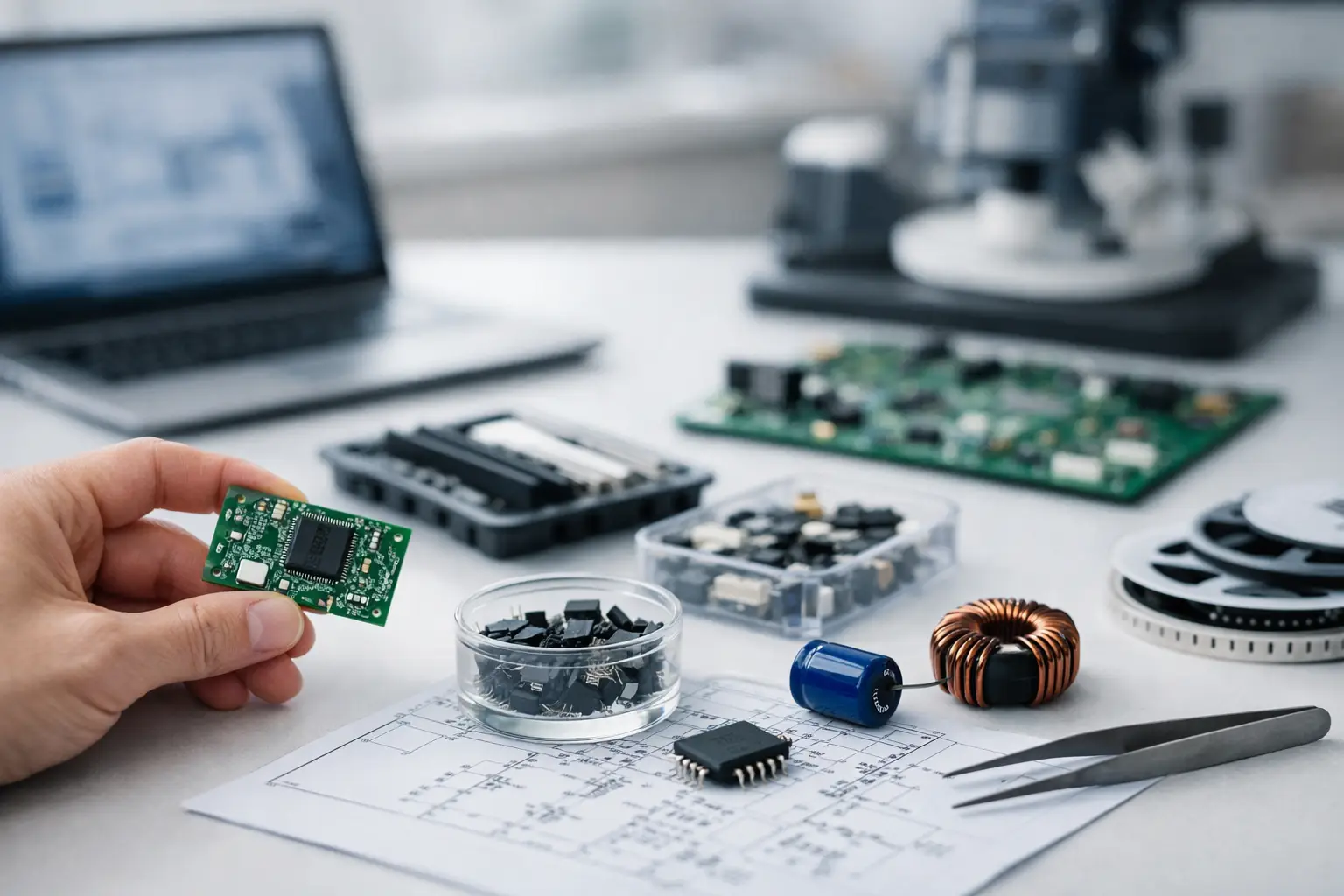
A component that is available for a prototype can still become the reason a production launch is delayed. Knowing how to source components is therefore not simply a purchasing task. It is a coordinated engineering, quality and supply-chain process that determines whether an electronic product can be built repeatedly, tested consistently and supported over its full lifecycle.
For industrial products, medical-adjacent equipment, connected devices and specialised electronics, the lowest unit price is rarely the right starting point. The objective is to secure the correct part, from a controlled source, at the required time, with documentation that supports production and traceability. That requires early decisions - ideally before the PCB layout and bill of materials are frozen.
Start with a production-ready bill of materials
Component sourcing begins with the bill of materials, or BOM. A BOM created for a laboratory prototype may identify only a manufacturer part number and a preferred distributor. That is often insufficient for series production. Procurement needs enough information to distinguish an approved component from a lookalike, assess supply risk and purchase it without introducing an uncontrolled change.
Each line should state the manufacturer, full manufacturer part number, package, value or specification, approved status and required quantity. Critical parts also need information such as temperature grade, qualification requirements, firmware or programming status, approved alternates and any customer-specific restrictions. For electromechanical components, drawings, colour references and connector keying can be just as important as the basic part number.
Engineering should avoid ambiguous descriptions such as “10 kΩ resistor, 0603” where the application has a defined tolerance, voltage, pulse rating or automotive requirement. Those characteristics affect both suitability and availability. Clear specifications give purchasers room to secure equivalent approved parts when necessary, without creating a quality risk.
A practical BOM also separates standard passives from allocation-sensitive semiconductors, custom parts and components with long manufacturing lead times. This lets the project team focus attention where a shortage would genuinely affect the delivery plan.
How to source components through qualified channels
Authorised distribution is generally the preferred channel for active components and parts with demanding traceability requirements. It provides a clearer chain of custody, manufacturer support and better protection against counterfeit or mishandled material. Direct manufacturer purchasing can be appropriate for high volumes, strategic supply agreements or parts that are not broadly distributed, although minimum order quantities and commercial commitments may apply.
Independent distributors can have a legitimate role when authorised stock is unavailable, especially during allocation or at end of life. The trade-off is higher verification effort. Before buying, the purchaser should assess supplier approval, lot traceability, storage conditions, inspection processes, return terms and proof of origin. A low-priced offer without these controls can create far greater costs in rework, field failures or a stopped production line.
For every new supplier, qualification should be proportionate to the component’s risk and the product’s application. A simple, non-critical mechanical item does not require the same scrutiny as a microcontroller, power semiconductor or safety-relevant connector. However, the process should be documented in both cases.
When reviewing an offer, confirm at least four points:
- the exact manufacturer part number and revision;
- the quantity physically available, rather than only indicated stock;
- the date code, lot information and packaging condition; and
- the delivery commitment, including whether the stock is already allocated elsewhere.
Make availability a design input, not a late problem
The best opportunity to reduce sourcing risk occurs during engineering. Selecting a component solely because it is technically elegant can create avoidable exposure if it has one manufacturing source, a volatile lead time or an uncertain product lifecycle. The alternative is not to compromise the design blindly. It is to assess technical performance and supply continuity together.
For critical ICs, power devices, displays, connectors and wireless modules, check whether there are pin-compatible alternatives, second-source options or functionally equivalent architectures. Sometimes a slightly higher component cost is justified because it avoids a single-source dependency. In other cases, redesigning for flexibility may add board area or validation effort. The right decision depends on annual volume, target price, product lifetime and the cost of interruption.
Approved vendor lists and approved alternates should be established by engineering, quality and procurement together. Procurement can identify market availability, but it should not substitute parts independently where form, fit or function is affected. Even a passive component substitution can alter reliability in high-voltage, high-frequency or harsh-environment applications.
At Hemargroup, this coordination can take place across engineering, procurement and production before materials are committed. The benefit is practical: design decisions are checked against assembly requirements, component availability and the route to scalable manufacturing, rather than being corrected after a prototype is complete.
Build traceability into the purchasing process
Traceability is what allows a manufacturer to connect a finished unit to the components, production order, inspection results and process conditions used to build it. Its required depth varies by sector, but a controlled record is valuable for almost every professional electronic product.
At a minimum, retain purchase orders, supplier confirmations, delivery notes, manufacturer labels and internal goods-receipt records. For critical items, record lot or date-code information and link it to the production batch. Incoming inspection should verify package integrity, label consistency, correct packaging format and any required certificates or declarations.
Storage is part of component control as well. Moisture-sensitive devices need appropriate dry storage and floor-life management before reflow soldering. Electrostatic-sensitive components require protected handling. Components with limited shelf life, such as certain adhesives, solder pastes or batteries, need stock rotation and clear expiry controls. A component can be genuine and correctly specified, yet still unsuitable if it has been stored or handled incorrectly.
Plan for lead times, allocation and lifecycle changes
Lead time should be treated as a planning variable, not a promise. A supplier may quote 16 weeks today and revise that figure tomorrow due to demand, wafer capacity, transport disruption or a manufacturer allocation policy. For a production programme, use several scenarios: normal lead time, extended lead time and a supply interruption case.
Demand forecasts are particularly useful when shared early with key suppliers. They improve the chance of securing capacity and allow purchasing to phase orders around production needs. For stable, long-running products, buffer stock may be sensible for high-risk components. Yet excessive inventory ties up capital and carries obsolescence risk, so stocking policy should reflect actual consumption and product maturity.
Lifecycle monitoring is equally important. Manufacturers may issue product change notifications, last-time-buy notices or end-of-life announcements with limited notice. Once a component is designed into a product, someone must own the review of these notices and decide whether to make a final purchase, qualify an alternate or redesign the affected circuit.
A one-off purchase may solve an immediate shortage, but it does not solve a five-year service commitment. Companies that sell equipment with maintenance obligations should source with repairability and after-sales availability in mind from the outset.
Balance unit cost against total programme cost
The cheapest quotation can conceal costs elsewhere. Split deliveries can increase receiving work and freight charges. Unapproved stock can require additional inspection. A substitute that needs revalidation can delay the project more than the price saving justifies. Conversely, paying a premium for verified, immediately available material may protect a production deadline with much higher commercial value.
A useful sourcing decision considers total landed cost, quality risk, lead-time confidence, minimum order quantity, payment terms, storage impact and the effort required to validate the part. For startups, cash flow and flexibility may carry more weight. For established industrial programmes, continuity, traceability and long-term pricing agreements may be the stronger priorities.
This is also where a purchasing team benefits from close contact with production planning. Ordering all material early may appear safe, but it can leave sensitive or fast-moving components in storage for too long. Ordering too late creates dependence on expedited freight and spot-market supply. A staged purchasing plan gives the project more control.
Keep decisions visible across the project team
Component sourcing works best when changes are visible to everyone affected. A weekly review of critical parts can bring together engineering, procurement, project management and production to discuss shortages, alternates, incoming quality issues and upcoming builds. The goal is not more administration. It is early action while there are still options.
For each critical BOM line, assign an owner and record the current status: approved source, available quantity, expected receipt date, alternative path and decision deadline. This simple discipline prevents a component issue from sitting unnoticed until the assembly date is already at risk.
A dependable supply chain is built one controlled decision at a time. Start by making the BOM precise, qualify the source before placing the order, and keep engineering involved whenever availability forces a change. That approach gives your team more than parts on a shelf - it gives you a product that can be manufactured and supported with confidence.