.png)
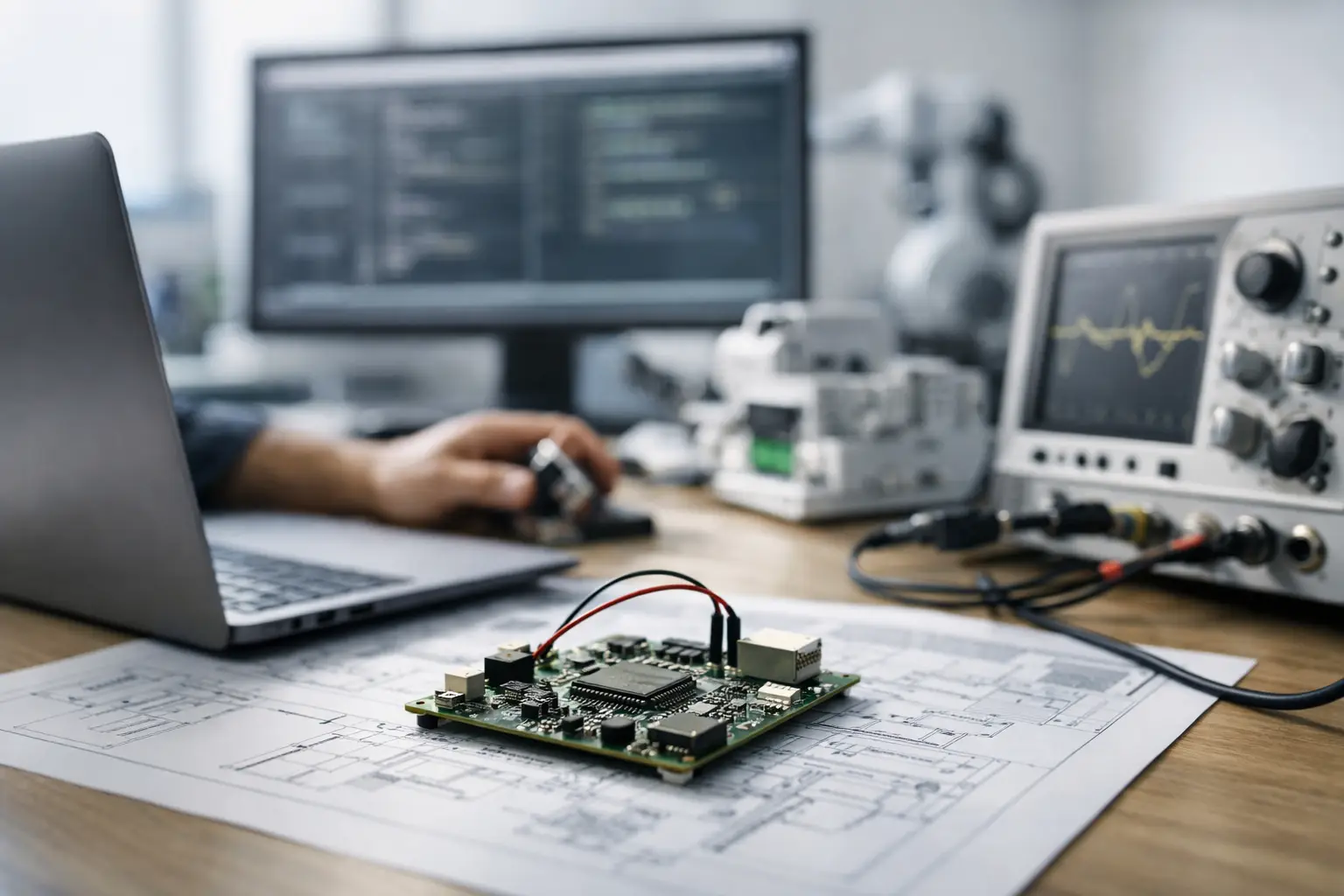
A prototype can appear complete on the bench, then stall when firmware timing changes expose a power issue, a connector cannot be assembled reliably, or a replacement component requires a board revision. Embedded hardware software co design addresses these problems before they become expensive. It brings electronics, firmware, mechanics and production requirements into the same technical conversation from the first architecture decisions.
For product teams, this is not simply a better way to organise engineering. It is a way to reduce redesign loops, make validation more meaningful and protect the path from prototype to series production. The earlier the dependencies between hardware and software are understood, the more predictable the development programme becomes.
Why embedded hardware software co design matters
An embedded product is a system, not a PCB plus code. The processor choice affects firmware architecture, boot time, memory availability, cybersecurity options and long-term component supply. The power design affects analogue measurement quality, radio performance, thermal behaviour and the operating modes that software can support. Even test-point access influences how efficiently each unit can be programmed and verified in production.
When hardware and software are developed in separate sequences, assumptions often become fixed too early. Hardware may be frozen around an interface that later proves difficult to use. Firmware teams may build around a development board whose peripherals, power behaviour or memory configuration differ from the final design. The result is familiar: late changes, additional prototype cycles and uncertainty about whether a successful lab test can be repeated at scale.
Co-design does not mean that every discipline performs the same work. It means each discipline contributes at the point where its decisions matter. Hardware engineers define the electrical architecture and layout constraints. Firmware engineers expose the real needs of drivers, communication stacks and update mechanisms. Manufacturing specialists assess assembly, programming, inspection and traceability. Product teams keep the decisions aligned with cost, timing and market requirements.
Start with the product behaviour, not the component list
The strongest co-design projects begin with how the device must behave in its real operating environment. A requirement such as "battery powered" is not sufficient. The engineering team needs to understand expected duty cycles, peak current, charging conditions, low-temperature behaviour, service life and whether the device must wake on a sensor, timer or remote command.
The same applies to connectivity. Selecting Bluetooth, Wi-Fi, cellular or a wired interface is only the beginning. Teams should define data volume, latency, antenna placement, commissioning workflow, security credentials, recovery behaviour and field-update requirements. These details affect the radio design, processor resources, enclosure, firmware structure and production process.
Define the architectural decisions early
A practical early-stage review should establish the processor and memory headroom, power domains, key interfaces, safety-related functions, diagnostic coverage and the anticipated manufacturing test approach. It should also identify which functions can be verified in software and which require electrical measurements or dedicated fixtures.
This is especially valuable for startups moving from a proof of concept to a commercial device. A development kit can demonstrate a feature quickly, but it rarely answers all questions about custom power management, EMC behaviour, assembly yield or test time. For established product businesses, the same review helps when upgrading a legacy device, replacing obsolete components or adding connected functions without compromising proven product performance.
Design interfaces that can be tested and maintained
Interfaces are where co-design either pays off or breaks down. Clear electrical and software interface definitions prevent teams from relying on undocumented assumptions about voltage levels, signal timing, pull-up resistors, reset sequences, bus ownership or error states.
Consider a sensor interface. Hardware needs to provide the correct supply stability, signal integrity and protection for the environment. Firmware needs to handle start-up timing, calibration data, communication errors and fault detection. Production needs a method to confirm that the sensor is connected and performing within acceptable limits. If these requirements are considered together, the final board can include the right test access and firmware self-test from the outset.
Programming and service interfaces deserve the same attention. A temporary connector may be acceptable for early prototypes, while a production device may need bed-of-nails access, controlled programming pads or an automated fixture. The right choice depends on expected volume, enclosure constraints, security requirements and the time allowed for each production unit. There is no universal solution, but there should be an intentional one.
Field updates are another common example. Over-the-air updating can add real product value, yet it requires memory allocation, secure boot arrangements, recovery handling and a clear policy for failed updates. Treating these as late firmware features can force avoidable hardware compromises. Designing for them early makes the product easier to support throughout its lifecycle.
Bring manufacturing into the engineering loop
A design that works electrically is not automatically ready for industrialisation. Component selection, PCB layout, panelisation, soldering access, package availability and inspection requirements all influence cost, yield and delivery reliability. Production input during development helps identify risks while changes are still manageable.
For example, a board may use technically suitable components that have limited sourcing options or difficult lead-time profiles. A second-source strategy, where technically possible, can reduce exposure without changing the product intent. Likewise, dense layouts may require careful review of component spacing, thermal relief, stencil design and automated optical inspection coverage. These are engineering decisions with direct production consequences.
Manufacturing readiness also includes traceability. Depending on the application, teams may need to record serial numbers, software versions, test results, key component batches or repair history. Building the identification and data flow into the product and process is more effective than trying to reconstruct it after production has started.
At Hemargroup, engineering, Swiss electronic assembly, procurement and lifecycle coordination can work as one operational chain. This creates a shorter feedback path between a design decision and its effect on sourcing, SMD or THT assembly, programming, testing and logistics. For customers, the benefit is clear accountability across the stages where product risk often transfers between suppliers.
Validate the system in stages
Co-design needs disciplined validation, not only good intentions. Early prototypes should test the highest-risk assumptions first: power consumption, thermal performance, radio range, analogue accuracy, software timing, mechanical fit or an unfamiliar component. This avoids spending development time polishing functions that depend on an unproven foundation.
As the design matures, validation should move from engineering checks to repeatable product verification. Firmware can support this process by providing production-test modes, readable diagnostics and controlled calibration routines. Hardware should provide safe, repeatable access to the signals and functions required by the test fixture. Together, they reduce manual work and make test results more consistent from unit to unit.
The transition through prototype, pre-series or 0-series production is particularly revealing. It tests more than the electronics. It shows whether documentation is complete, programming is reliable, components arrive as expected, assembly instructions are unambiguous and quality checks can be performed at the required pace. Findings from this stage should feed directly into the next revision rather than being treated as isolated production issues.
Make trade-offs visible before they become delays
Embedded development is full of legitimate trade-offs. A lower-cost processor may require tighter memory management. A smaller enclosure can limit antenna performance and thermal dissipation. A highly integrated component can simplify layout but increase supply-chain dependency. The purpose of co-design is not to remove these trade-offs. It is to make them visible to the people who can assess their consequences.
The right level of effort also depends on the product. A low-volume industrial controller, a connected consumer device and a safety-sensitive instrument will require different validation depth, test infrastructure and documentation. What should remain consistent is the cross-functional decision process: requirements are traceable, assumptions are challenged early and changes are assessed across engineering and production.
A well-run co-design process leaves a product team with more than a functioning prototype. It creates a device that can be manufactured, tested, serviced and evolved with confidence. When the next design decision is taken, the most useful question is often not "does this work now?" but "will this still work when we build, support and scale it?"