
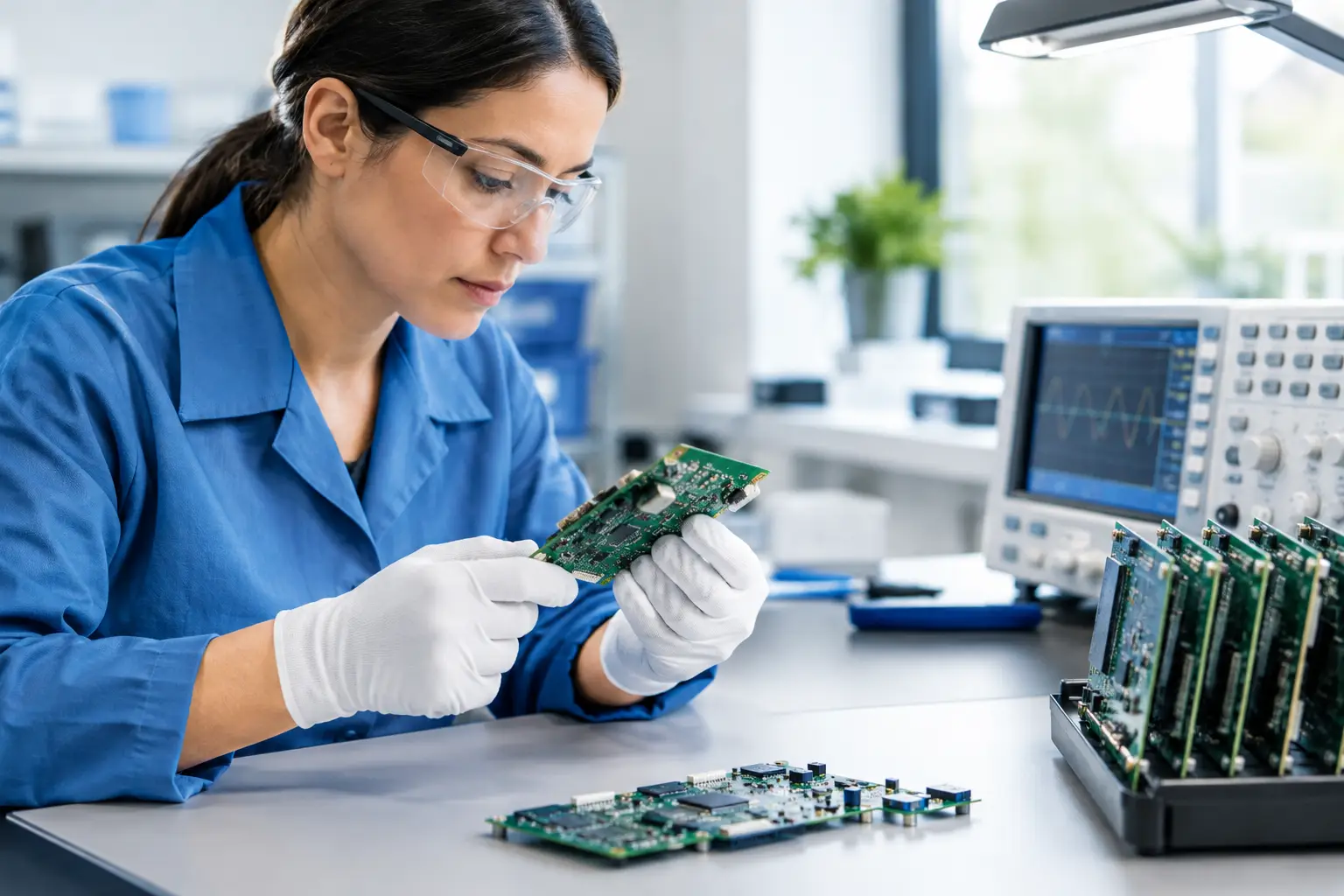
A product can pass functional testing on the production line and still create costly problems in the field. A connector may loosen after transport, a substituted component may alter performance, or a programming step may be applied to the wrong hardware revision. Electronics quality management is the discipline that prevents these gaps by connecting engineering decisions, supplier control, assembly processes, test evidence and after-sales feedback.
For product managers, R&D teams and procurement leaders, quality is not a final inspection activity. It is a controlled way of taking a product from a first prototype to repeatable, traceable production without losing the intent of the original design.
Electronics Quality Management Starts Before Production
The most expensive defects are often introduced before the first PCB reaches the assembly line. A design that is difficult to assemble, impossible to test efficiently or dependent on a single hard-to-source component can look correct in a prototype and become unstable when volumes increase.
Quality planning should therefore begin during engineering. Circuit design, PCB layout, component selection and mechanical integration need to be reviewed with manufacturing in mind. This is where design for manufacturability and design for testability become practical controls rather than theoretical principles. Clear fiducials, accessible test points, component spacing, polarity markings and defined programming interfaces all reduce the chance of variation later.
The same applies to documentation. A production-ready package should identify the approved bill of materials, Gerber and assembly files, revision status, programming requirements, test specifications, cosmetic criteria and packing instructions. When the specification is incomplete, operators and suppliers are forced to make assumptions. Assumptions are not a quality system.
For early-stage teams, this level of discipline may feel disproportionate to a small pilot run. It is usually the opposite. A well-documented 0-series exposes process weaknesses while changes are still manageable. It also creates the foundation needed when demand moves from dozens of units to hundreds or thousands.
Build Quality Into Sourcing Decisions
Component procurement has a direct effect on product consistency. The correct manufacturer part number is only one part of the question. Teams also need to consider lifecycle status, approved alternates, traceability, storage requirements, counterfeit risk and the consequences of supply interruptions.
A controlled sourcing process links every purchased component to an approved bill of materials and a known source. If an alternative is required, engineering should assess it before it enters production. A similar-looking substitute can change tolerances, firmware behaviour, thermal performance or long-term availability.
This does not mean every alternative must be rejected. In fact, dual sourcing and qualified substitutes can protect continuity. The trade-off is that each approved change needs a documented technical decision and, where necessary, validation through testing. Speed matters during shortages, but uncontrolled substitutions transfer risk directly into the finished device.
Material handling also deserves attention. Moisture-sensitive devices, electrostatic-sensitive parts and components with date-code restrictions require defined receiving, storage and issue procedures. Quality management is as much about preserving good material as it is about finding bad material.
Process Control on the Assembly Floor
Manufacturing quality depends on repeatability. On an SMD or THT assembly line, that means defining the process before production begins and monitoring the conditions that can affect the result. Stencil design, solder paste handling, placement programmes, reflow profiles, selective soldering parameters and visual inspection criteria all need to correspond to the specific product.
A first article inspection is valuable because it confirms that the process produces the intended result before a full lot is completed. It should verify more than solder joints. It can check component values and orientation, PCB revision, labels, mechanical fit, programmed firmware and the output of functional tests.
During serial production, inspection methods should match the risk of the product. Automated optical inspection can identify placement, polarity and soldering anomalies. X-ray inspection can be appropriate for hidden joints such as BGAs. In-circuit testing, boundary scan or functional testing can verify electrical performance. No single method covers every failure mode, so the right combination depends on the design, use case, expected volume and consequences of failure.
For example, a simple board with accessible signals may benefit from an efficient functional test fixture. A safety-relevant industrial module may justify more extensive test coverage and tighter process validation. The objective is not to add checks for their own sake. It is to detect meaningful defects as early as possible, with evidence that the product meets its requirements.
Traceability Turns Evidence Into Control
Traceability gives a manufacturer and its customer the ability to answer basic but critical questions: Which material was used in this unit? Which software version was programmed? Which test results were recorded? Who performed the rework, and why?
At a practical level, this often includes batch or serial numbers, material lot references, production dates, operator or machine records, inspection results and test data. The required depth varies. A consumer accessory produced in high volume may need batch-level traceability, while a medical, transport or industrial system may require unit-level records throughout its service life.
Traceability has a cost. Serialisation, data capture and record retention require systems and disciplined execution. Yet without them, a quality issue can expand from a limited, identifiable batch into a broad and expensive containment action. Good records make it possible to isolate affected units, investigate the cause and protect unaffected stock.
They also improve customer communication. When a non-conformity is reported, the response should be factual: identify the product configuration, review the production history, contain the risk and document corrective action. This is faster and more credible than relying on memory or incomplete paperwork.
Manage Non-Conformities Without Hiding Them
Defects are not proof that a process has failed. Uncontrolled defects are. A mature quality process makes non-conformities visible, separates affected material, records the issue and determines whether rework, repair, concession or scrap is appropriate.
Rework requires particular control in electronics manufacturing. It may be technically possible to replace a component or correct a solder joint, but the work must not introduce heat damage, lifted pads, contamination or an undocumented configuration change. Reworked assemblies should be inspected and tested against defined criteria before release.
The investigation should then go beyond the individual unit. Was the issue caused by an incorrect work instruction, a supplier lot, an assembly parameter, a design weakness or a test gap? Corrective and preventive action is useful only when it changes the conditions that allowed the issue to occur. Repeating inspections without addressing the cause simply delays the next failure.
Quality Extends Through the Product Lifecycle
A product does not stop changing after its first production release. Components become obsolete, customer requirements evolve, firmware is updated and field data reveals conditions that laboratory testing did not reproduce. Electronics quality management needs a formal route for handling these changes.
Change control should define what is changing, why it is necessary, which units are affected, what validation is required and when the new revision becomes effective. This applies equally to a component replacement, a PCB layout update, a new programming file or a packaging change. Mixing revisions without clear control can create service problems long after production has ended.
After-sales returns and repairs are especially valuable sources of information. A returned unit should be treated as data, not merely as a warranty cost. Failure analysis can reveal installation errors, transport damage, component weaknesses or patterns that require engineering action. The learning should flow back into design, production instructions, test procedures and supplier decisions.
This integrated view is why many companies prefer one accountable partner across engineering, industrialisation, manufacturing, logistics and service. Hemargroup brings those functions together so that production feedback can reach the people responsible for the design, while product changes remain controlled across the supply chain.
What to Expect From an EMS Quality Partner
When assessing an electronics manufacturing services partner, certifications matter, but they are not the entire answer. Ask how the partner manages revisions, approves component alternatives, records test outcomes, controls rework and communicates when an issue is found. The quality system should be visible in the day-to-day process, not only in a certificate on the wall.
It is also worth discussing the level of quality control required for the product. Over-specifying inspection can add cost and delay without improving meaningful reliability. Under-specifying it can leave expensive risks undiscovered. A capable partner will help define a proportionate plan based on the product's application, regulatory needs, production volume and field-service expectations.
The best time to establish that plan is before the production schedule is under pressure. Bring manufacturing, engineering and procurement into the same conversation while the design can still be improved. The result is not simply a cleaner production run. It is a product whose quality can be demonstrated, maintained and supported throughout its working life.