.png)
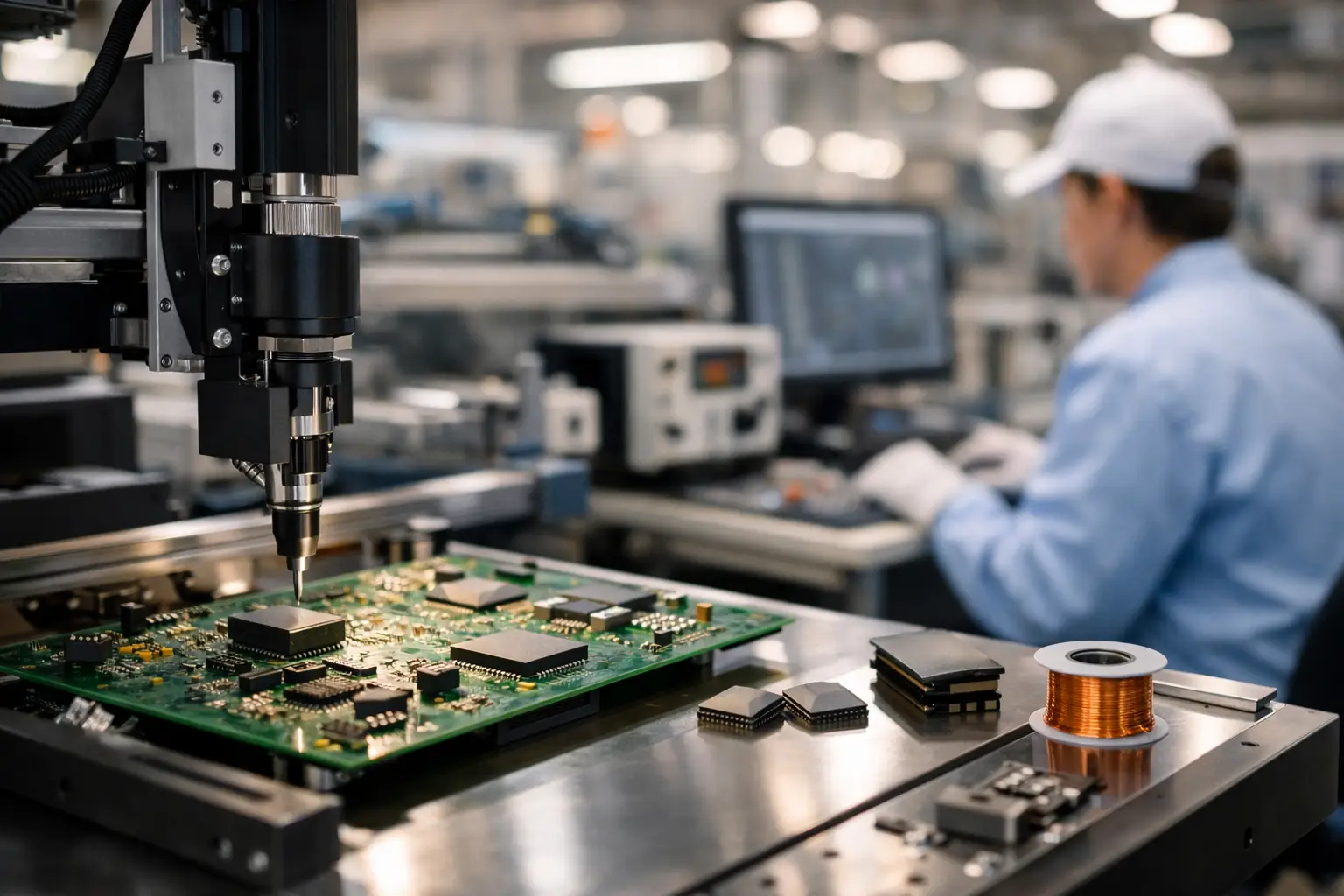
A working prototype proves that an idea can function. It does not yet prove that the product can be built repeatedly, tested efficiently, supplied reliably, repaired when needed, and delivered at the expected cost. The electronics industrialization process closes that gap between technical promise and controlled production.
For product managers, engineering teams and founders, this phase is where many hidden risks become visible. A component may be difficult to source, a PCB layout may slow assembly, a test point may be inaccessible, or a mechanical tolerance may create inconsistent final builds. Addressing these issues before volume production protects lead times, quality and investment.
What electronics industrialization is designed to achieve
Industrialization converts an approved product design into a production-ready system. It is not simply the handover of CAD files, Gerber data and a bill of materials to a manufacturer. It is a structured engineering and manufacturing activity that defines how the product will be assembled, programmed, inspected, tested, packaged and supported throughout its lifecycle.
The output should be a stable process, not merely a stable product. That distinction matters. Two units can perform identically on an engineer’s bench while requiring very different levels of effort to manufacture. One may be straightforward to assemble and verify. The other may depend on manual adjustments, hard-to-find parts or specialist knowledge held by one person.
A well-managed industrialization phase creates clear production documentation, controlled revisions, realistic sourcing options and measurable quality criteria. It also builds traceability into the product from the beginning, allowing teams to connect components, production data, test results and serial numbers when investigation or service is required.
Start with a design review for manufacture
The first practical step is a joint review between product engineering and manufacturing. Design for manufacturing, design for test and design for assembly should be considered together. Treating them as separate checks usually creates late changes and avoidable iterations.
For the PCB, the review considers pad geometry, component spacing, panelisation, soldering profiles, fiducials, board finish and the practical limits of SMD and THT assembly. For device-level products, it extends to housing tolerances, cable routing, connector access, labelling and final mechanical assembly. The goal is not to compromise the function of the product. It is to find a way to preserve that function with repeatable production methods.
Testability deserves early attention. If a device requires functional verification, the design needs accessible test points, a defined programming interface and a realistic test sequence. A product that can only be checked through a time-consuming manual procedure may be acceptable for ten prototypes but not for a recurring series. The right approach depends on annual volume, product complexity, regulatory requirements and the cost of a field failure.
Documentation is part of the product
Manufacturing depends on accurate, controlled information. The industrialization package commonly includes released schematics, PCB production data, assembly drawings, pick-and-place files, bill of materials, approved component alternatives, programming instructions, test specifications, work instructions and packaging requirements.
Each document needs revision control. Otherwise, teams can build an approved PCB with an outdated firmware release, a superseded resistor value or the wrong enclosure label. Clear change management is particularly valuable when engineering updates continue after the first series has started.
Build a supply chain that can support the product
The bill of materials may look complete while still carrying significant procurement risk. A part can be technically suitable but have long lead times, limited supplier availability, end-of-life exposure or a minimum order quantity that does not suit the planned production volume.
During industrialization, procurement and engineering should review critical components together. This includes semiconductors, connectors, displays, batteries, specialised passive components and parts tied to safety or certification requirements. Where appropriate, qualified alternatives can be prepared before shortages occur. However, substitution is not always simple. A replacement component may require electrical validation, firmware adaptation, a new soldering profile or renewed compliance checks.
This is why component strategy must be connected to design decisions. Selecting a widely available alternative early can reduce future disruption, but it may increase unit cost or use more PCB area. There is no universal answer. For a medical, industrial or long-lifecycle product, continuity may justify a different choice than for a short-run consumer device.
A capable EMS partner also checks whether the intended material flow supports the production plan. That includes ordering lead times, incoming inspection, storage conditions for moisture-sensitive devices, lot management and the availability of materials for service and repair work later in the lifecycle.
Prove the process with pilot production
A pilot build, often called a 0-series, is where the documentation meets real production conditions. It should be treated as a learning exercise with defined objectives, not as a ceremonial pre-production run.
The first units reveal details that digital design reviews cannot always expose: a feeder setup that is inefficient, a connector that is difficult to insert, a programming cycle that takes too long, or a test fixture that needs refinement. Production engineers can assess assembly time, first-pass yield, rework needs and inspection results. Product engineers can verify that the process has not introduced functional or cosmetic issues.
The key is to capture deviations systematically. Every issue needs a decision: accept it, correct it in the design, improve the work instruction, modify tooling or change the process. Informal fixes on the production floor may solve an immediate problem, but they do not create a controlled production method.
Test fixtures should match the production need
Test development often has the strongest influence on throughput and quality. At low volume, an operator-guided functional test may be the most sensible option. It keeps initial equipment costs low and allows flexibility while the product is evolving. As volumes rise, dedicated fixtures, automated programming and data capture can reduce test time and variation.
The right level of automation depends on the expected production quantity and the consequences of a defect. A fixture is an investment, so it should be justified by cycle-time savings, repeatability, quality requirements or the need to record test data for each serialised unit. Industrialization is the point at which that business case can be assessed with real data rather than assumptions.
Establish quality, traceability and release criteria
Quality assurance should be designed into the workflow, not added as a final inspection step. Incoming material controls, solder paste inspection where appropriate, optical inspection, functional testing and final visual checks each address different risks. No single inspection method can confirm everything.
Traceability gives these controls their operational value. When a product is serialised, production records can show which PCB revision, component lots, firmware version and test results were associated with a specific unit. This is valuable for regulated applications, but it is equally useful for ordinary industrial products when investigating a customer return or analysing a recurring fault.
Before production release, the project team should agree acceptance criteria for the product and process. These may cover electrical performance, visual standards, test limits, packaging, labels, documentation completeness and permitted rework. The criteria should be clear enough that production, quality and the customer reach the same decision when a borderline unit appears.
Plan beyond the first production order
Industrialization is sometimes viewed as a one-time milestone. In reality, it establishes the operating model for the product’s life. Component obsolescence, firmware updates, supplier changes, regulatory updates and customer feedback can all trigger controlled changes after release.
That is why engineering, production, procurement, logistics and after-sales teams need a shared view of the product configuration. A disconnected handover may work at launch, then become difficult when the same device needs a repair three years later or a replacement part is no longer available. Lifecycle planning includes repairability, spare-part strategy, packaging, warehousing and the management of engineering change notices.
For startups, this planning prevents a successful first launch from becoming a supply challenge. For established companies, it supports predictable upgrades and continuity across product generations. In both cases, a single accountable partner across engineering, production and lifecycle services can reduce the friction created by multiple handovers.
Choosing the right industrialization partner
The best partner is not necessarily the one with the lowest assembly quotation. Electronics industrialization requires manufacturing knowledge, but it also requires the willingness to question a design constructively, coordinate supply-chain decisions and work through unresolved details without losing momentum.
Look for practical experience across PCB assembly, device integration, programming, test development, quality systems and sourcing. Ask how pilot-build findings are documented, how revisions are controlled, how traceability is maintained and who owns communication when a component becomes unavailable. The answers indicate whether the supplier can support a product beyond a single production order.
Hemargroup brings engineering, Swiss electronic manufacturing, procurement coordination and lifecycle services together so that these decisions can be managed as one connected process. This supports teams from early prototypes through 0-series builds, scaled production and after-sales requirements.
A production-ready product is not defined by the day its first units leave the line. It is defined by the confidence that the next units can be built to the same standard, with the same information, and with a clear response when conditions change.