.png)
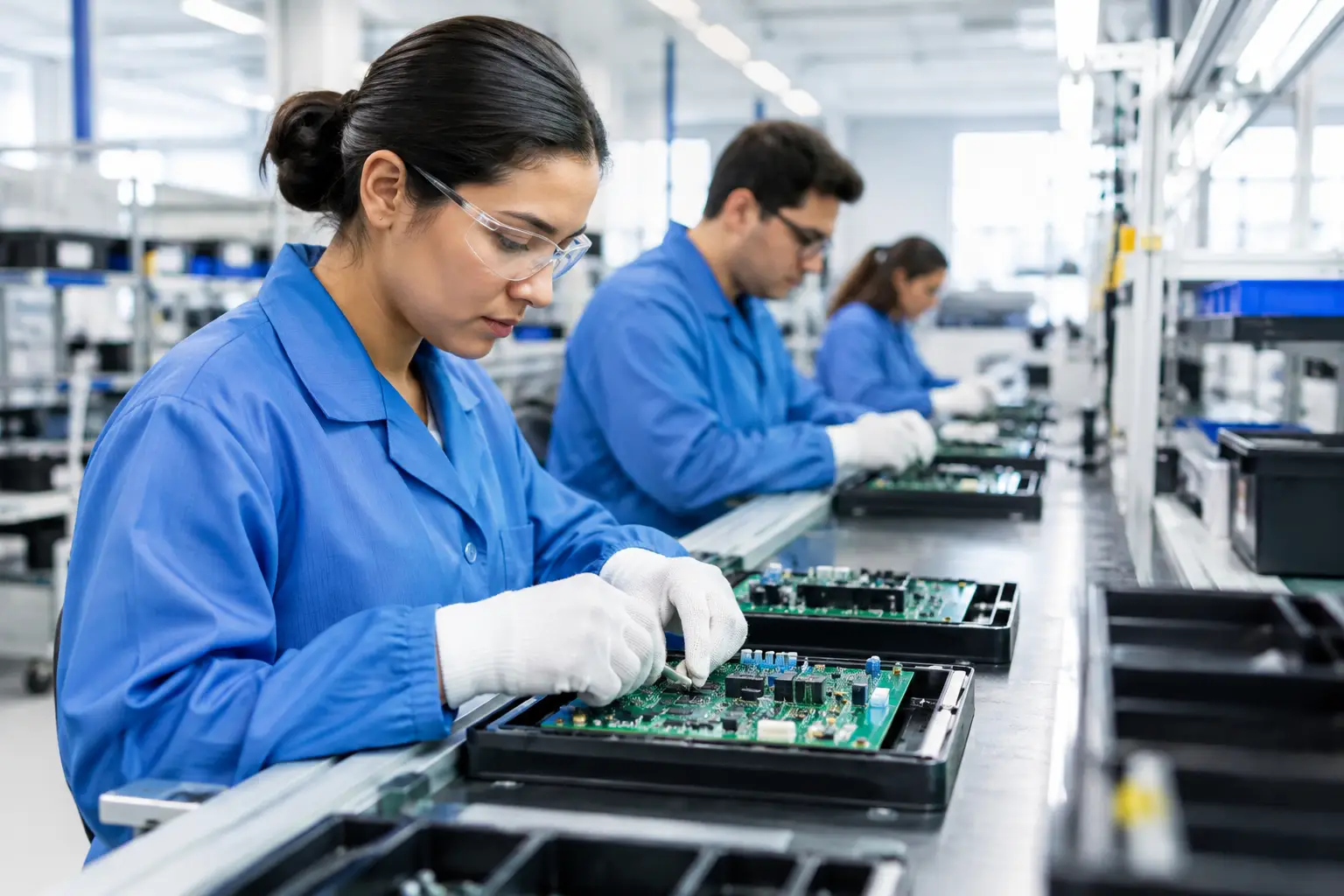
A prototype that works on an engineer’s bench is only the first proof point. The more difficult test is whether the same product can be built repeatedly, tested consistently, supplied despite component volatility, and supported after shipment. Electronics contract manufacturing is the discipline that turns that test into a controlled process.
For product companies, the right manufacturing partner does more than place components on a PCB. It brings engineering, sourcing, production, quality control and logistics into one operating model. That reduces handovers, shortens feedback loops and gives the product team clearer ownership from the first prototype to series production.
What electronics contract manufacturing should cover
Electronics contract manufacturing, often called EMS, can range from PCB assembly alone to full device delivery. The difference matters. A supplier that receives finished production files and assembles boards serves one need. A partner that can also review the design, source components, industrialise the product, assemble its mechanics, test it and manage its lifecycle serves another.
Neither model is automatically better. A mature company with an established design-for-manufacturing process, approved supplier base and internal test expertise may only require specialist assembly capacity. A startup, a company introducing a new product platform, or an operations team replacing fragmented suppliers will often benefit from broader responsibility under one partner.
The most useful scope is defined by the product's actual risks. These commonly include component availability, production yield, regulatory requirements, firmware programming, test coverage, traceability and delivery reliability. A capable EMS partner addresses these risks early, not after the first production batch has exposed them.
From design intent to a manufacturable product
Manufacturing decisions begin during engineering. Circuit design, PCB layout, component selection and mechanical constraints all affect what happens on the production floor. A footprint that is technically correct but difficult to inspect, a component with a single source, or a test point that cannot be reached after assembly can create avoidable delays later.
Engineering for production, not only for function
Design-for-manufacturing reviews translate engineering intent into repeatable assembly. This includes checking pad geometries, panelisation, soldering access, component spacing, polarity marking and the mix of SMD and THT technologies. It also considers programming steps, calibration needs and whether operators can build and inspect the product without ambiguity.
Virtual layout checks and simulation can help identify issues before physical boards are ordered. The goal is not to slow development with unnecessary controls. It is to remove expensive corrections when materials have been purchased and a production slot is already planned.
For a first prototype, some manual workarounds may be reasonable. For a 0-series or scaled product, they must be assessed honestly. A process that depends on one experienced technician can be acceptable for ten units but unsuitable for hundreds or thousands. Industrialisation converts individual know-how into documented instructions, tooling, fixtures and test routines.
Prototyping and 0-series production
Fast prototypes are valuable because they make decisions visible. They validate electrical function, firmware behaviour, mechanical fit and user interaction. Yet a prototype should also start the manufacturing conversation. Early bills of materials, assembly data and test concepts give procurement and production teams time to identify constraints.
A 0-series is where the product is tested as a production system. It reveals whether components arrive as expected, whether the assembly sequence is practical, whether test limits are meaningful and whether packaging protects the finished device. It is often the best opportunity to improve yield before the cost of change increases.
Sourcing is part of product quality
A well-designed board cannot be manufactured predictably without controlled component procurement. Lead times, allocation, lifecycle status and authorised supply channels can determine whether a launch date holds. This is particularly relevant for devices using specialised semiconductors, connectors or passive components with tightly specified characteristics.
An EMS partner should manage procurement as an active technical function. That means monitoring availability, verifying approved alternatives, communicating changes before they become urgent and maintaining appropriate traceability. Substitutions should never be treated as a purchasing-only decision. A replacement component may affect electrical performance, certification, programming or mechanical assembly.
There is also a balance between stock protection and capital tied up in inventory. For stable, long-running products, strategic purchasing can protect continuity. For a product still changing rapidly, buying too far ahead can create obsolete stock. The right policy depends on forecast confidence, supplier lead times, product maturity and the cost of a missed delivery.
Quality is built into the production route
Quality assurance is strongest when it is designed around the specific product rather than applied as a generic final inspection. The production route may include solder paste inspection, optical inspection, X-ray checks where required, functional testing, firmware programming, calibration and final visual control. The appropriate combination depends on the technology, volume and consequence of failure.
Traceability is equally important. When a field issue occurs, the team should be able to identify the production batch, material lot, assembly data, test result and relevant process history. This supports efficient root-cause analysis and targeted corrective action instead of broad assumptions or unnecessary recalls.
Test strategy deserves particular attention. A functional test confirms that a device behaves as intended under defined conditions. It does not always detect every assembly defect, and inspection does not always confirm full functionality. Effective quality planning uses each method for what it can reliably prove.
For regulated, industrial or safety-relevant applications, documentation requirements may be more extensive. For a compact consumer IoT device, speed and cost may carry greater weight. In both cases, the process must match the product's risk profile rather than rely on a standard checklist.
Choosing an electronics contract manufacturing partner
Selecting an EMS provider is not only a capacity decision. It is a decision about how quickly the partner understands technical questions, how transparently it manages exceptions and who remains accountable when a product moves from design to production.
Start by examining the handovers. If engineering, assembly, procurement and logistics are separate organisations, ask how technical changes travel between them and who owns the outcome. Multiple specialists can work well, but they demand disciplined coordination from the customer. An integrated partner can reduce that management load by keeping the same project knowledge across functions.
Then look beyond nominal production volume. Ask how prototypes, small batches and ramp-up work are handled. Many products need fast, responsive support before they need high-volume capacity. The partner should be able to move from express prototype work to controlled series production without forcing a complete process reset.
The following questions reveal more than a general capability presentation:
- How are design-for-manufacturing findings documented and closed?
- What traceability is available for components, assemblies and test results?
- Who approves component alternatives and engineering changes?
- How are programming, functional testing and rework controlled?
- What happens when a component becomes unavailable during production?
- Can the partner manage warehousing, packaging, repairs and after-sales requirements?
Lifecycle ownership after shipment
Production is not the end of the product's technical life. Devices may need repair, rework, firmware updates, spare-part planning, revised packaging or controlled end-of-life management. A product that is easy to manufacture today can become difficult to support if build records, approved materials and test procedures are not maintained.
This is where a full-service EMS model creates practical value. With engineering, manufacturing and lifecycle services connected, product changes can be assessed across their real consequences. A new firmware release may alter programming and test steps. A replacement connector may require a layout update, a revised work instruction and updated stock management. These dependencies are easier to control when the responsible teams work from the same project information.
Hemargroup brings this approach together through dedicated engineering, Swiss production, procurement coordination and lifecycle support. For customers, the objective is straightforward: one accountable team that can keep the product moving while preserving the level of control required for the application.
Build the manufacturing plan before the deadline
The best time to engage manufacturing expertise is before the design is frozen and the launch date is under pressure. Share the expected volume range, likely product changes, target markets, test requirements and service expectations early. That gives the production team the information needed to recommend a realistic route from concept to delivered device.
A well-planned electronics manufacturing relationship does not remove every supply or technical challenge. It gives the project a faster way to see issues, decide on trade-offs and act before they become costly. That is how a promising electronic design becomes a product customers can receive, use and rely on.