.png)
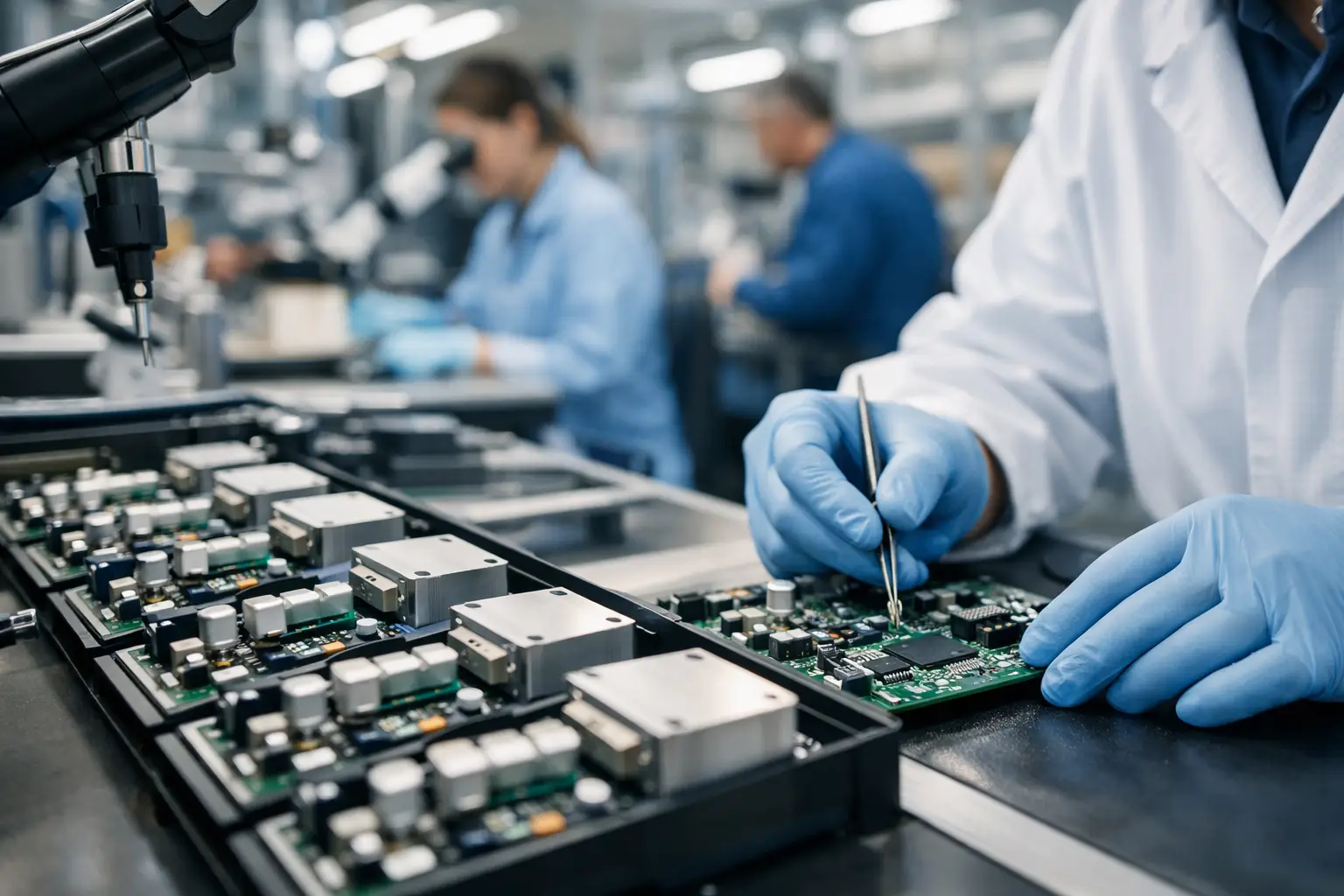
A device can perform perfectly on an engineer’s bench and still fail to become a dependable product. The difference often appears in component availability, soldering tolerances, firmware control, enclosure fit, test coverage and the ability to repeat the same result hundreds or thousands of times. An electronic device assembly service should therefore do more than populate a PCB. It should turn a validated design into a controlled, traceable and scalable product.
For product managers, procurement teams and founders, this changes the selection criteria. Unit price matters, but it is not the only cost that affects a launch. Delays caused by an obsolete component, unclear production data or a late mechanical change can be far more expensive than a small saving in assembly.
Assembly starts before the first board is built
Electronic device assembly is the point where engineering decisions meet production reality. A manufacturing partner needs complete and usable data: bills of materials, schematics, PCB files, assembly drawings, firmware versions, test instructions, approved alternatives and mechanical documentation. When these inputs are incomplete or disconnected, production teams are forced to interpret intent. That creates avoidable variation.
A capable service reviews the product before release, not after a problem occurs. This review considers whether selected components can be sourced reliably, whether packages suit the intended assembly process, whether test points are accessible, and whether the device can be assembled efficiently without compromising quality. It also considers the practical relationship between the electronics, housing, cables, labels and final packaging.
This is particularly relevant for products moving from a prototype or 0-series into serial production. A prototype may use hand-soldered connections, readily available development modules or components selected for immediate availability. Those choices can be appropriate early on. Before industrialisation, however, the product must be assessed for repeatability, supply continuity and testability.
What an electronic device assembly service should cover
The right scope depends on the maturity of the product and the capabilities already available in-house. An established industrial company may provide validated production data and require specialist SMD and THT assembly capacity. A startup may need support from circuit design through to logistics. In both cases, accountability is clearer when the handovers between engineering, purchasing, assembly and quality are actively managed.
Engineering transfer and production readiness
The first task is to make the design buildable. This includes checking manufacturing files, confirming component references, defining approved substitutions and aligning the revision status of hardware and software. Small inconsistencies can have large consequences. A revised resistor value, an uncommunicated firmware update or an outdated placement file can lead to rework, scrapped material or a product that behaves differently in the field.
Design-for-manufacture feedback is most valuable before parts are ordered. It may identify a connector that is difficult to access after mechanical assembly, a package that requires a different stencil strategy, or a layout feature that reduces automated optical inspection coverage. Such feedback is not about changing a design for the sake of production. It is about making informed trade-offs between performance, cost, lead time and production reliability.
Procurement with continuity in mind
Component sourcing is no longer a simple purchasing activity. Lead times, allocation, minimum order quantities, end-of-life notices and counterfeit risk all affect delivery. A service partner should maintain clear visibility of the approved bill of materials and communicate sourcing risks early enough for the customer to decide.
There is no universal rule that the lowest-cost component is the correct choice. For a short pilot run, a readily available alternative may be sensible. For a regulated or long-life industrial product, maintaining qualification records and securing lifecycle availability can be more important. The best approach depends on expected volumes, product lifetime, approval requirements and the consequences of a design change.
PCB assembly and device integration
At board level, production may combine SMD placement, reflow soldering, selective processes and THT assembly. Process selection depends on component technology, board design and required volumes. Automated assembly supports consistency and throughput, while manual operations remain necessary for certain connectors, large components, cables, displays and specialised assemblies.
Device-level work extends beyond the PCB. It can include programming, mounting electronics in housings, fitting wiring harnesses, applying labels, assembling mechanical parts and preparing retail or industrial packaging. This is where a device becomes a product ready for its intended environment, rather than a set of finished electronic boards.
A practical assembly process should also allow for controlled changes. Serial products evolve: suppliers change, firmware is updated, labels are revised and customer options are added. Revision control ensures that each unit is built to the correct specification and that the production record can show exactly what was used.
Testing, quality assurance and traceability
Inspection alone cannot guarantee functional quality. Visual checks and automated optical inspection can identify many soldering or placement defects, but they do not confirm that a programmed device communicates correctly, reads a sensor accurately or performs safely under operating conditions.
A suitable test strategy is defined around the product’s risks. It may include in-circuit testing, functional testing, programming verification, calibration, burn-in or final acceptance checks. The key is not to apply every possible test. It is to apply the tests that detect meaningful failures at the right stage, with clear pass and fail criteria.
Traceability gives these controls operational value. Depending on the application, it can connect a serial number to production date, component batches, firmware version, operator steps and test results. This supports quality analysis, customer service and targeted corrective action if a field issue is reported. The required depth of traceability varies. A consumer accessory and a medical, industrial or transport-related device will not have the same requirements.
Moving from prototype to serial production without losing control
The transition to volume is rarely linear. A pilot build often exposes details that are invisible in CAD files: tolerances in the enclosure, cable-routing constraints, programming time, weak test contacts or unexpected variation in supplied parts. These findings should feed back into engineering and process documentation before the next build.
Short production runs are valuable because they create evidence. They confirm assembly time, yield, test duration and material consumption under real conditions. They also allow the customer and manufacturer to agree on acceptance standards before volumes increase. Skipping this stage may appear faster, but it commonly shifts risk into the first serial order.
Production scaling should be planned around demand rather than assumed at the outset. Some products require frequent, smaller batches to protect against design changes or uncertain forecasts. Others benefit from larger purchases that secure supply and reduce unit cost. Warehousing, packaging and release schedules should follow the same logic. The correct model is the one that protects availability without tying up unnecessary capital in stock.
One accountable path across the product lifecycle
Managing separate engineering, PCB assembly, mechanical integration and logistics suppliers can work, especially where an organisation has strong internal project control. It also creates more interfaces, more revision handovers and more opportunities for responsibility to become unclear when a problem crosses disciplines.
An integrated EMS model reduces that friction. Engineering feedback can reach production quickly, purchasing can flag component risks before a redesign becomes urgent, and test data can inform corrective action. For customers, the benefit is not simply convenience. It is faster decision-making and a clearer owner for product continuity.
Hemargroup brings hardware and software engineering, Swiss manufacturing, procurement coordination, warehousing and lifecycle services into one operating model. This supports projects that begin with an early concept as well as established products requiring reliable assembly, controlled scaling or after-sales repair.
Questions to ask before selecting a partner
A productive discussion should go beyond machine capacity and quoted lead time. Ask how the partner manages engineering changes after a build has started, how component alternatives are approved, and how firmware versions are controlled. Clarify which tests are performed, what evidence is retained and how non-conforming units are handled.
It is equally useful to discuss the difficult scenarios. What happens if a critical part becomes unavailable? Can the partner support an urgent prototype alongside serial production? Who coordinates rework if a mechanical issue is found during final assembly? Clear answers reveal whether the service is designed for real project conditions or only for an ideal production release.
The strongest assembly relationship is built before the first order is placed. Give the production team visibility of the product roadmap, expected demand and likely changes. In return, expect practical feedback that helps the product remain buildable, serviceable and available long after its first successful batch.